Archaeology
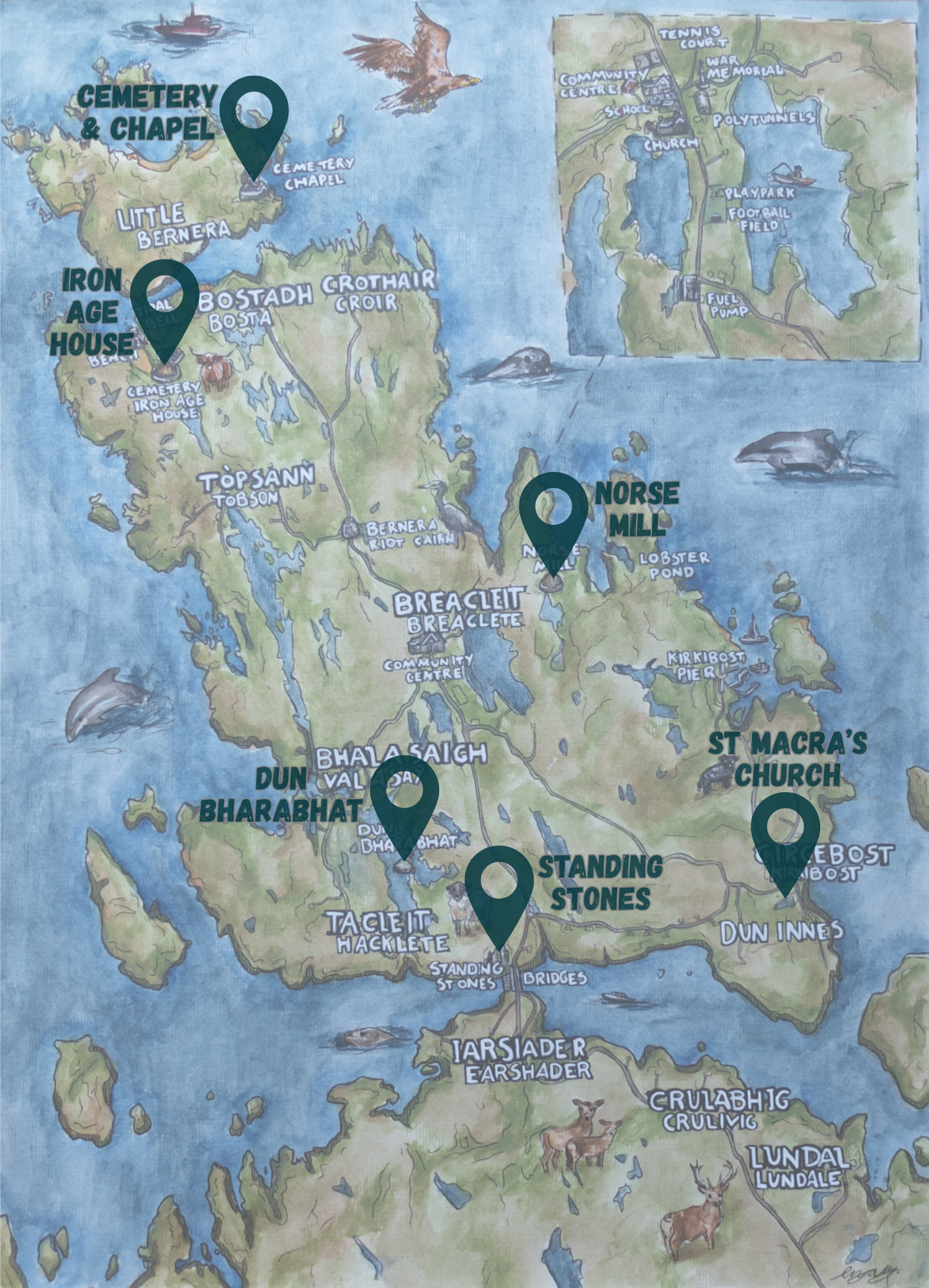
There are thought to be about 150 sites of archaeological interest on Bernera. These are mainly old croft houses, shielings (summer shelters) and fanks (sheep pens), but there are also a few very notable sites. Details can be below the location map.
the iron age house
Bernera’s best known archaeological site is the Iron Age Village at Bosta Beach (pronounced Borsta) which was uncovered, and subsequently excavated, in 1996 following a severe winter storm.
Although there is little to see today of the archaeological find (since the site was re-covered to protect the five houses found), the Bernera Historical Society has accurately recreated one of the houses based on the measurements taken by the excavation team.
This House can be found at the head of Bosta Beach a few hundred metres from the original site.
During the summer months guided tours of the House are offered and artefacts from the dig are displayed in the Bernera Museum.
Entry to the House and Museum can be arranged out of season on request. See this page for more information.
duns & brochs
The word broch, originating from the Old Norse borg and the German burg which means castle or fortress, describes a number of stone roundhouses that were constructed during the period from 300BC to 400AD.
Smaller brochs are called duns, and there are four of these known in Bernera, although three are now merely outlines in the ground (Dun Stuigh at Croir, Dun Tiddaborra near Dun Innes and Dun Bharraglom near the bridge). The most intact is Dun Bharabhat, constructed on a small islet in Loch Bharabhat.
This dun is reachable at low water via a causeway and some of the walls are still standing. For details on how to reach the dun, see our Walks page.
Pottery from Loch Bharabhat was recovered in 2015 and is now on display in the Bernera Museum.
neolithic standing stones
The Standing Stones at Bernera Bridge are part of the Callanish Complex and are known as Callanish VIII. Their Gaelic name is Cleitir.
The site is fascinating because it has no parallel elsewhere in the British Isles. It may be called a ‘stone circle’ but actually it is a semi-circle in a unique position.
J.G.Callandar described it well: “Occupying a very unusual position on a steep rocky slope ending in a cliff, which rises sheer some 40 feet out of the water at the narrow strait … on the south shore of Great Bernera … are three standing stones and a prostrate pillar stone.”
To reach the site, park at the Bernera side of the bridge and climb up a few steps next to the picnic tables.
the norse mill
A restored Norse Mill, just a short walk from Breaclete, gives an idea of how grains would have been milled, and flour produced, in times past.
The walls of the mill would have been constructed from stones, peat and clay found nearby, and the roof from driftwood (or other wood) and covered with turf.
The mill consists of two levels. The upper level contains the millstones and a wooden hopper to allow grain to flow into the hole in the centre of the stones. In the lower level are the paddles, which are activated when water from the adjacent stream is chanelled through the mill chute.
The water comes from a freshwater loch located just above the mill and flows down a steep burn to join the sea right next to the mill. Sluice gates further upstream, whose remains are still visible, would have been opened to allow water to be re-directed towards the mill when required.
St Macra's Church, Kirkibost
The remains of a Late Mediaeval church dedicated to St Macra is situated near the shore towards the south end of Kirkibost, overlooking East Loch Roag.
It is a simple rectangular building orientated a little N of E. The masonry is of roughly hewn stone with pinnings bonded with shell and lime mortar. Its internal measurements are 17.3m by 4.9m within walls 0.7m thick and 1.8m high.
Much of the N wall has been repaired in a make-shift way. A stretch of walling in the mid part of the S wall has fallen. There are the remains of three windows and an entrance (now blocked) in the S wall. The W gable has one window. There are no internal architectural details.
Parallel to the N wall of the church, and 1.4m away, is a feature consisting of a raised rectangular mound set with several large embedded boulders. There is no graveyard in evidence.
Source: www.hebrideanconnections.com
sites on Little Bernera
On Little Bernera can be found the remains of at least four chapels, with the oldest dating back to early Christian times.
The cemetery on the southeast part of the island was the burial place for Bernera and the people from East Loch Roag until the early 20th century.
A small dig by the shore below the ‘modern’ cemetery in 2020 has shown that there were early Christian burials—and possibly Iron Age as well—at this location, making it a long used burial site for the people of the area.
There are also indications at this site for possible Neolithic activity as well.
More information about Little Bernera can be found here.
There is also a chambered cairn on the coast near Hacklete and a beehive monks’ cell on Eilean Fir Chrothair (a small island near Croir).
Further details about all the archaeological sites on this page can be found in the Bernera Museum.