
fishing
Bernera is blessed with many different types of fishing, in both freshwater and sea lochs, which are suitable for anglers of all experience. Whether you are with kids having fun on their first time outing, or on an all-night vigil looking for a British record, there are some excellent fishing opportunities available in and around our island.
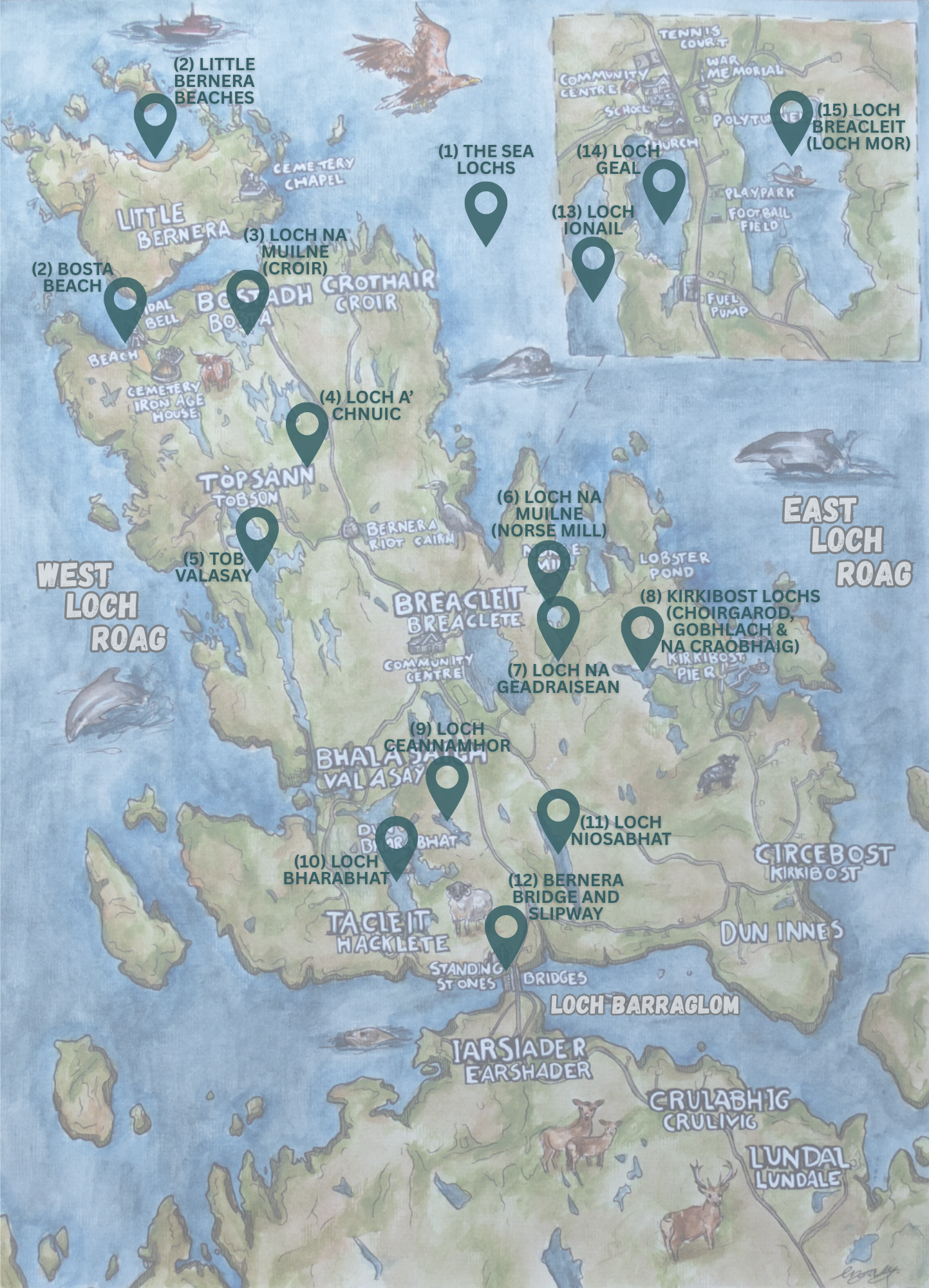
Our map gives suggestions of some of the best places in Bernera to fish. Click on the button below the map for further details of each location.
freshwater trout
There are a lot of good trout fishing lochs in Bernera, and most are fished from the shore using fly, bait or spinner.
Most of the lochs are easily accessible from the road, and it’s rare to encounter other anglers, which makes it a real pleasure having peace and quiet just chilling on the shore watching nature go by.
When parking your vehicle try not to completely block off a passing place as this makes it awkward for other road users. Also take care not to damage fences or leave any gates open when gaining access to lochs in the villages.
mackerel & herring
Mackerel can be very plentiful in the sea lochs in July and August and are great for kids that don’t have the patience for bottom fishing when the bites are few and far between.
The best time to fish for mackerel is on the flood tide between half tide and high water. Mackerel are a pelagic species so they can be found anywhere in the water column from up near the surface to down near the bottom.
Traditionally fished with traces of six feathered hooks, nowadays the shiny foil types have taken over. However, if the mackerel are plentiful they will take anything and it is not uncommon to catch six at a time.
Herring can be fished around June, preferably at dusk. They are often near the surface and prefer a trace with no feathers, just plain silver hooks (no rust).
haddock
Haddock have been caught off the shore east of the village of Croir on the sandy ground only in late May and early June. Fantastic if you can catch them but they don’t come in that far every year.
They are normally caught with a trace of three rubber squids baited with mackerel, sand eels or mussels. They usually come in shallow in May and wander back out to the 30 fathom line late summer.
Haddock have a soft mouth and are easily lost if reeled in too quickly. The last few years the fishing has been blighted by a plague of so called endangered Spurdogs which, as well as getting caught, can leave you with half a fish on your line.
Take care unhooking any Spurdogs as they will try to stab you with a two-inch long spike on their back!
pollack & saithe
Most of the rocky coast can be productive for pollack and saithe using long straggly rubber sand eel type lures trolled slowly through the water. When large pollack strike they put all their strength into the first five seconds of the fight and dive down for the kelp. You will need strong equipment to cope with this initial surge.
Boat or kayak access can get you to the rocks and reefs where they lurk. They will normally be found on the sheltered side of the tide of a rocky underwater reef. So as soon as you drift over the top of an underwater pinnacle get ready for a powerful strike.
cod & ling
Cod and ling are usually found around the harder rocky ground, and usually deeper than 40 metres.
They are fished on the bottom with fairly large mackerel baits. A shiny flashing lure will help attract them. Many a ling can also be got by adding the lid of a can of beans to the tackle.
monster skate
Loch Roag is the home of the official British Shore caught record for skate. Caught by local angler Gordon Mackenzie, it weighed a massive 169lb 6oz.
This is a specialist fishery with specialist tackle usually involving an all night session with large groundbaits. The best spots to fish for skate are actually further in the loch, away from the ocean.
flats (flounders & Turbot)
The beaches at Bosta and Little Bernera will produce a few flats such as Dabs Flounders and Turbot.
Most beaches in the Hebrides are fished with small mackerel groundbaits just outside the breaking surf on an ebbing tide. As the tide goes out the sandeels buried in the sand move out and the predators are waiting for them.
As well as flats, sea trout are often caught using this method.
With thanks to Iain Angus Macaulay of Kirkibost for providing the content for this page.