what to see & do
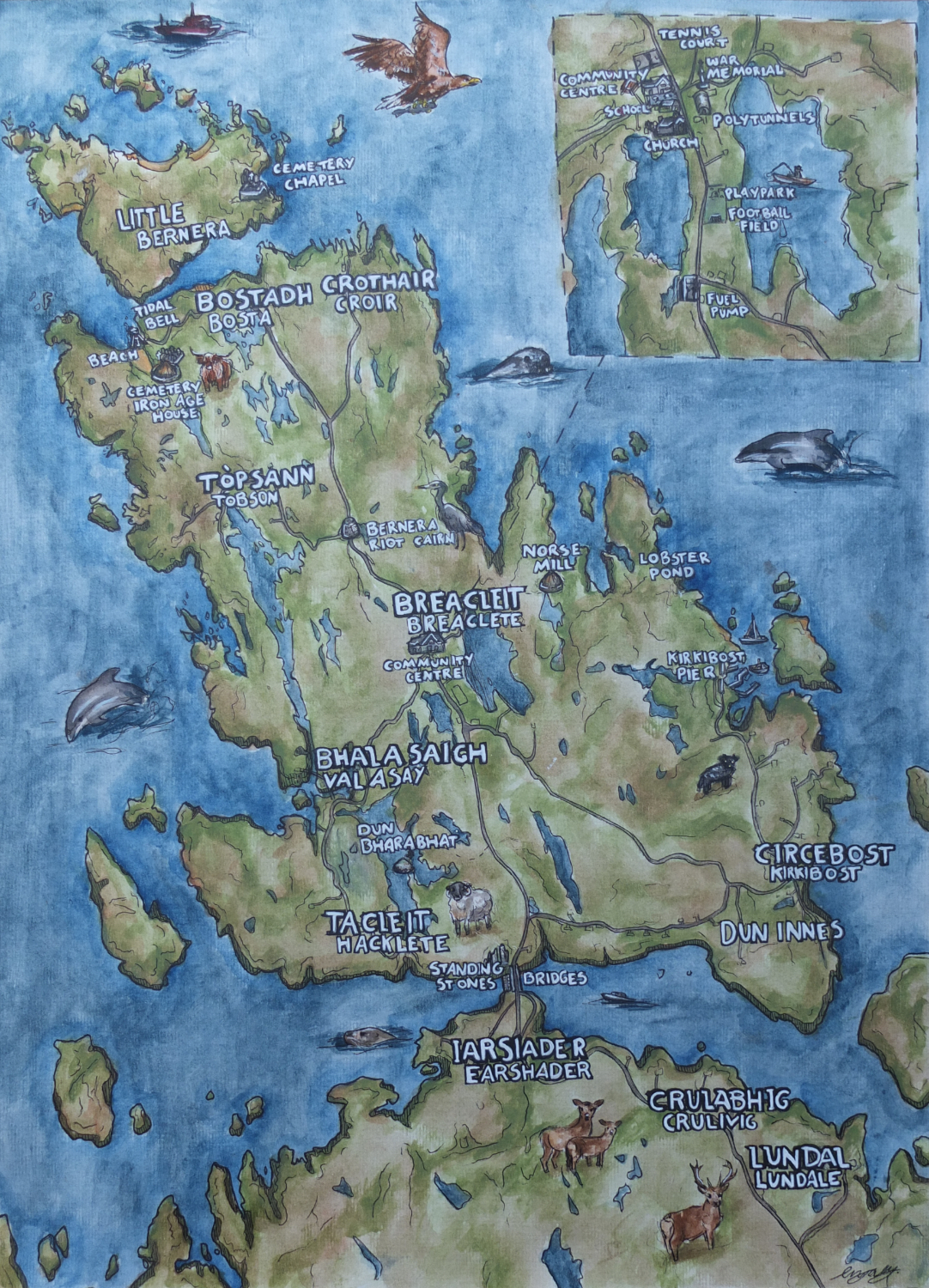
Great Bernera is approximately 5 miles long and 3 miles wide. Once you cross the ‘Bridge over the Atlantic’ you will find the delights of the Hebrides in microcosm. We have wonderful scenery and wildlife, great walks, standing stones and brochs, a beautiful beach with its own Iron Age House and lots more.
Below is a selection of things to see and do in Bernera. More information about each site can be found in Bernera Museum.
the bernera bridges
The first landmark you’ll encounter when arriving on the island of Great Bernera is the ‘Bridge over the Atlantic’, or rather the two bridges over the tidal lochs Barraglom and Roag, which surround the island.
The picnic tables in this photo are on the Bernera side of the bridges. On the right is the original bridge, constructed in 1953. On the left is the new bridge which was opened in 2021.
The land at the other side of the bridge is called Tir Mor—literally ‘big land’, since to the islanders, Tir Mor would have indeed been the mainland.
The original bridge was a major breakthrough for British civil engineering at the time. On the day it opened it was estimated that up to 4000 people crossed over the bridge to explore the island of Great Bernera for the first time.
However, in 2020, a survey revealed some serious structural weaknesses and a new bridge was constructed, officially opening on 15 December 2021.
neolithic standing stones
Right above the picnic tables at the bridge are three neolithic Standing Stones. These are part of the Callanish Complex and are known as Callanish VIII. Their Gaelic name is Cleitir. A few steps lead up to the Stones from the picnic area.
These stones are fascinating because the site has no parallel elsewhere in the British Isles. It may be called a ‘stone circle’ but actually it is a semi-circle in a unique position.
J.G.Callandar described it well: “Occupying a very unusual position on a steep rocky slope ending in a cliff, which rises sheer some 40 feet out of the water at the narrow strait … on the south shore of Great Bernera … are three standing stones and a prostrate pillar stone.”
The Museum (located in the Community Centre in Breaclete) is run by the Bernera Historical Society, who promote and sustain the identity and cultural heritage of Bernera and Tir Mor through collecting, recording, conserving and curating evidence of the history and culture of the area and its people.
Our fully-accredited Museum tells the story of Bernera on display boards and in presentation cases.
It is open between May and September, Monday-Friday from 12-4pm.
For more information and the latest updates, please check the Museum website.
bosta beach and iron age house
Probably Great Bernera’s best known landmark is Bosta Beach, a sheltered, sandy cove at the north end of the island, with crystal clear waters and offshore rock stacks.
People flock to Bosta Beach in the summer for various activities, such as swimming, snorkelling and kayaking. It’s common to see folk exercising dogs, playing ballsports or ambling down the hill overlooking the beach as part of the Great Bernera Walk.
And of course many go there simply to relax or to have a picnic or barbecue. If you stay long enough, you may hear the tidal bell (one of only eleven such bells in the UK) ringing the turn of the tide.
And there is also a reconstruction of an Iron Age house, which offers guided tours from May-Sept, Monday-Friday, 12-4pm. For more information about the Iron Age House see here.
Across the water from the idyllic Bosta Beach lies the smaller, uninhabited island of Little Bernera (and is the reason for the ‘Great’ in Great Bernera).
Little Bernera is roughly one mile east to west by half a mile from north to south and its highest point is 42m above sea level. At the closest point, Little Bernera and Great Bernera are no more than about 50 metres apart.
The west and south sides of Little Bernera are jagged and rocky but on the east and northeast shores there are long, sandy beaches, outlying islands and crystal clear, aquamarine waters.
Remains of dwellings and chapels provide evidence of centuries of settlement. However, in 1825, the last of the inhabitants were forcibly evicted when the island became part of a neighbouring farmstead.
The only really significant remains to be seen today are the cemetery and chapel at the eastern side of the island. The ancient graveyard was in use until the beginning of the 20th century, but erosion is now taking its toll and some of the gravestones are starting to be claimed by the sea.
There is no public transport to Little Bernera, however it’s possible to reach the island by kayak, by private hire or (for the more adventurous) by swimming there. Whatever means of transport you choose, on a calm and sunny day the trip is definitely worth it!
bernera riot cairn
In 1874, an event known as the ‘Bernera Riot’ took place on the Isle of Lewis.
Probably somewhat less dramatic than it sounds, the ‘riot’ involved around 150 men, accompanied by a piper, marching over 15 miles to Stornoway where Bernera crofter Angus MacDonald had been incarcerated in the town’s police station overnight.
The story goes that MacDonald had been accused of being one of the ‘ringleaders’ in an uprising against the tyrannical behaviour of the landlord’s representative, a Donald Munro, at the time when the Isle of Lewis was under the ‘ownership’ of the wealthy baron Sir James Matheson.
Munro, together with two accomplices, had attempted to evict 57 families in Great Bernera from the land they’d crofted for generations, in order to make way for a hunting and sporting estate.
When the 150-strong group reached Stornoway, MacDonald was released from the police cell and they all continued their march to Lews Castle to appeal to Matheson himself, who professed ignorance of the whole affair and promised to look into it. Then the men marched peacefully home.
However, three months later, MacDonald and two other ‘ringleaders’ were summoned to court on a charge of assaulting one of Munro’s accomplices on the day of the attempted eviction. Fortunately, their defence lawyer, a man named Charles Innes, showed outstanding adeptness during the long trial, resulting in the Bernera men being exonerated.
As undramatic as this riot may sound, it did in fact have very dramatic repercussions on crofting laws in Scotland. At the time, families with the traditional right to work the land were being unjustly evicted in many parts of the country by the landed gentry in what were termed the ‘Highland and Island Clearances’.
The Bernera Riot was the first in a series of Land Wars which consequently led to the Crofters’ Holdings (Scotland) Act being passed in 1886, which granted security to crofters and established a court to mediate on land disputes.
The importance of the event to Bernera was commemorated in the erection in 1992 of the Riot Cairn, built with stones from every croft in Bernera. The Riot Cairn is located at the junction of the road to Tobson.
One of the most popular things to do when visiting Bernera is the West Coast footpath, a circular route starting at the Community Centre in Breaclete.
This 4-hour walk takes you along the coast, over hills and past lochs to Bosta Beach and the Iron Age House, returning to Breaclete via the main road, and passing the Bernera Riot Cairn on the way.
More details about this route can be found on our Walks page.
the norse mill
A shorter walk takes you to a restored Norse Mill, which gives an idea of how grains would have been milled, and flour produced, in times past.
The walls of the mill would have been constructed from stones, peat and clay found nearby, and the roof from driftwood (or other wood) and covered with turf.
The mill consists of two levels. The upper level contains the millstones and a wooden hopper to allow grain to flow into the hole in the centre of the stones. In the lower level are the paddles, which are activated when water from the adjacent stream is chanelled through the mill chute.
The water comes from a freshwater loch located just above the mill and flows down a steep burn to join the sea right next to the mill. Sluice gates further upstream, whose remains are still visible, would have been opened to allow water to be re-directed towards the mill when required.
For directions on how to reach the Norse Mill check out our Walks page.
Dun Bharabhat is one of around 600 brochs (or dùns) in Scotland. The word broch, originating from the Old Norse borg and the German burg meaning castle or fortress, describes a number of stone roundhouses that were constructed during the period from 300BC to 400AD.
It’s not clear whether their purpose was primarily as a fortress, as a place of refuge for people and animals, or as a sign of wealth, status and prestige, however Dun Bharabhat, located on a small oval-shaped islet in a freshwater loch, lends credence to the idea that its primary function was defensive.
The broch covers the whole of the islet and is approximately 12m long by 9m wide. The north wall is the most intact, at around 3m high and one metre thick, and there are remnants of an entrance on the east side. Excavations in the 1980s revealed three main galleries, a hearth, items of pottery and some animal bones and teeth.
The loch is not tidal, but in drier months its water level can sink low enough to uncover a 30m-long causeway, allowing access to the dun without wet feet. When the loch is full, only the tops of a few stones can be seen.
For directions on how to reach Dun Bharabhat check out our Walks page.
fishing
Bernera is blessed with many different types of fishing, in both freshwater and sea lochs. Many of the fishing sites are easily accessible from the road and it’s rare to encounter other anglers, which makes it a real pleasure having peace and quiet while chilling on the shore watching nature go by.
Fishing in Bernera is suitable for anglers of all experience, ranging from kids having fun on their first time outing to all-night vigils looking for a British record, which we have had in Loch Roag.
For more information and guidance on fishing opportunities in Bernera, please check out our Fishing page.